


When Hotel Systems Meet Harsh Conditions
Have you already trialled access control systems designed for hotels, only to find they struggle to survive in the environment you operate in?
Or have you heard enough stories about unreliable access, flat batteries, or connection issues that sticking with physical keys still feels like the safest option?
These concerns are completely valid — and they’re exactly why Blyx exists.
Most FIFO villages, workforce accommodation sites, and remote facilities aren’t hotels. Guests don’t experience them like hotels, and the infrastructure certainly doesn’t behave like one. So why rely on systems designed for air-conditioned lobbies and mild climates, then expect them to perform reliably in dust, heat, vibration, and isolation?
Our focus has always been simple:
design the system around the environment it must survive in — and the scenario it must support.
Guest Experience Still Matters — Just Differently
Just because a site isn’t a hotel doesn’t mean the guest experience should suffer.
It just needs to be fit-for-purpose.
With Blyx, guests can:
- Receive confirmation of their room before leaving home
- Arrive on site and go straight to their room — no queues, no keys
- Check opening hours, meal times, and menus from their phone
- Share dietary or medical requirements in advance, so facilities can prepare properly
It’s a smoother experience for guests — and far less manual handling for staff.
But none of this works if the system itself becomes the weakest link.
Reliability Comes First
In challenging environments, hardware and connectivity matter just as much as software.
What we’ve seen repeatedly is that many access systems — wireless and even some wired options — place their electronics directly inside the external door handle. That exposes critical components to heat, dust, moisture, and constant temperature swings.
It never made sense to us.
So we redesigned the approach.
Electronics Where They Perform Best
With Blyx, the core door controller electronics are installed inside the room, not in the handle.
Protected from weather extremes, these electronics operate at stable temperatures and deliver long-term reliability. They’re housed neatly inside a standard electrical mounting block, meaning they visually blend in like a power point or light switch.
Maintenance is simple:
- Covers are easy to remove
- Available in black or white
- Inexpensive to replace if damaged or outdated
No bulky hardware. No exposed electronics.
Wired for Consistency — Not Batteries
The Blyx Door Controller connects to the network via Cat6, providing both power and data through a network switch.
This approach:
- Eliminates batteries entirely
- Removes performance variability
- Enables consistent, frequent data communication
- Reduces ongoing maintenance costs
In many retrofits, Cat6 cabling already exists from previous internet installations — and where it doesn’t, it can often be pulled through existing pathways with minimal disruption.
Access That Doesn’t Force a Door Upgrade
Blyx controls the door using an electric striker and RFID reader — not a proprietary handle.
That means:
- You don’t need to replace your existing door furniture
- Fly screens still close properly
- Mechanical keys remain available as a fallback
- You choose the hardware that suits your infrastructure
All cabling between the controller, striker, and reader is supplied pre-terminated, simplifying installation and long-term maintenance.
The only externally exposed component is the RFID reader — housed in a sealed enclosure with easily replaceable electronics. It’s also the lowest-cost component in the system, so replacement (if ever required) is straightforward.
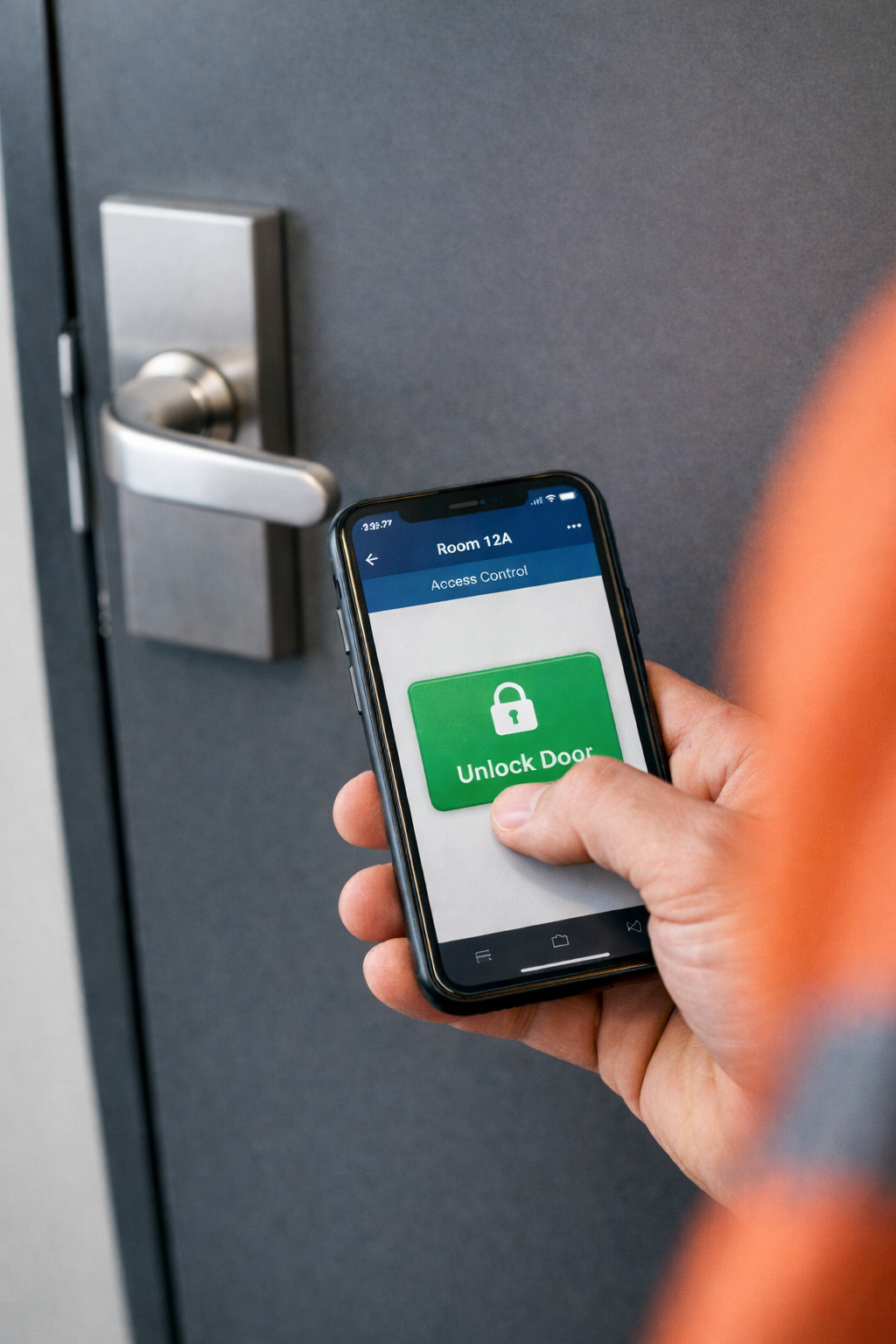
And even if the reader is temporarily unavailable, guests can still access their room via the Blyx App, or staff can remotely unlock the door.
Designed for Retrofit — Not Rebuild
Retrofits are often expensive because systems demand changes to suit their limitations.
Blyx does the opposite.
We adapt to what’s already there:
- A wide range of compatible strikers and handles
- Flexible cable lengths to suit existing pathways
- Electronics placed where they make sense — not where the product dictates
This flexibility is a major reason Blyx consistently comes in significantly more cost-effective than alternative systems, even before operational savings are considered — particularly when those alternatives still can’t deliver the same reliability or outcomes.
Built for Data, Not Just Doors
At its core, Blyx is about data — and data only has value if it’s reliable.
Remote locations taught us a lot. Wireless sounds appealing on paper, but real-world conditions expose its limits. Blyx is engineered to operate where connectivity, climate, and maintenance access are all working against you.
And access control is just the start.
Every Blyx installation also supports the Environment Controller — providing visibility and control over room conditions. The operational savings delivered by this device alone are often what truly sets Blyx apart.
Purpose-Built for Where You Operate
If you’re considering systems already known for:
- Struggling with heat
- Requiring frequent battery replacement
- Becoming unreliable when connectivity drops
- Forcing expensive building or door upgrades
It may be time to look at a system designed from the ground up for harsh, remote environments.
Blyx is engineered to last, built to adapt, and priced to surprise.