


Swipe to Send Information, Not Just Open Doors
Smarter Operations Don’t Always Need More Devices
In many accommodation facilities today, the push to collect better operational data has led to an increase in devices being introduced across the site. Tablets are often issued to staff so they can update job status, report maintenance issues, or confirm completed work.
In theory, this improves visibility. In reality, it can introduce new challenges.
Devices need to be charged, monitored, maintained, and replaced when damaged. They can slow staff down if they are complicated to use, and in busy environments they can easily be misplaced or forgotten.
Sometimes improving operational insight isn’t about adding more technology — it’s about using the systems you already have more intelligently.
That’s exactly the thinking behind the Blyx ecosystem.
Improving the Existing Process
Let’s take a simple example: room maintenance and housekeeping in FIFO accommodation.
The typical process is familiar.
Rooms are flagged for cleaning either because a guest has changed or because the same person has occupied the room for a number of days. A housekeeping supervisor prepares a list of rooms for the team, often noting whether the room requires a full clean or a mid-swing clean. They may also indicate which rooms have arrivals that day so staff can prioritise their work.
Staff then collect a master key and begin their cleaning run.
The process works, but it also leaves gaps in visibility for management and introduces unnecessary security risks with shared master keys.
Removing the Master Key
With Blyx, the master key is no longer required.
Room allocations can simply be uploaded as a roster, allowing the system to grant access to the specific rooms assigned to each staff member. Their access card will only open the rooms they are responsible for.
To make things even clearer for staff, a colour can be assigned to that roster. When the staff member arrives at the correct room, the RFID reader will display their designated colour, providing a simple visual confirmation that they are at the right location.
This improves both security and operational clarity without adding complexity.
Understanding What Is Happening in Real Time
While staff are completing their tasks, Blyx can record where their access card has been presented. Combined with door open and close events, the system can estimate how long a staff member has spent inside each room.
For many facilities this information alone is enough to confirm that the clean has likely been completed.
But Blyx prefers not to rely on assumptions when a better option exists.
Communicating Task Status Without Extra Devices
Traditionally, once a cleaning run is complete the staff member returns their checklist to the office. That sheet of paper confirms whether rooms were cleaned, skipped, or if maintenance issues were discovered.
Managers sometimes need this information earlier, which is why many facilities introduce tablets so staff can update the system in real time.
Blyx offers another option.
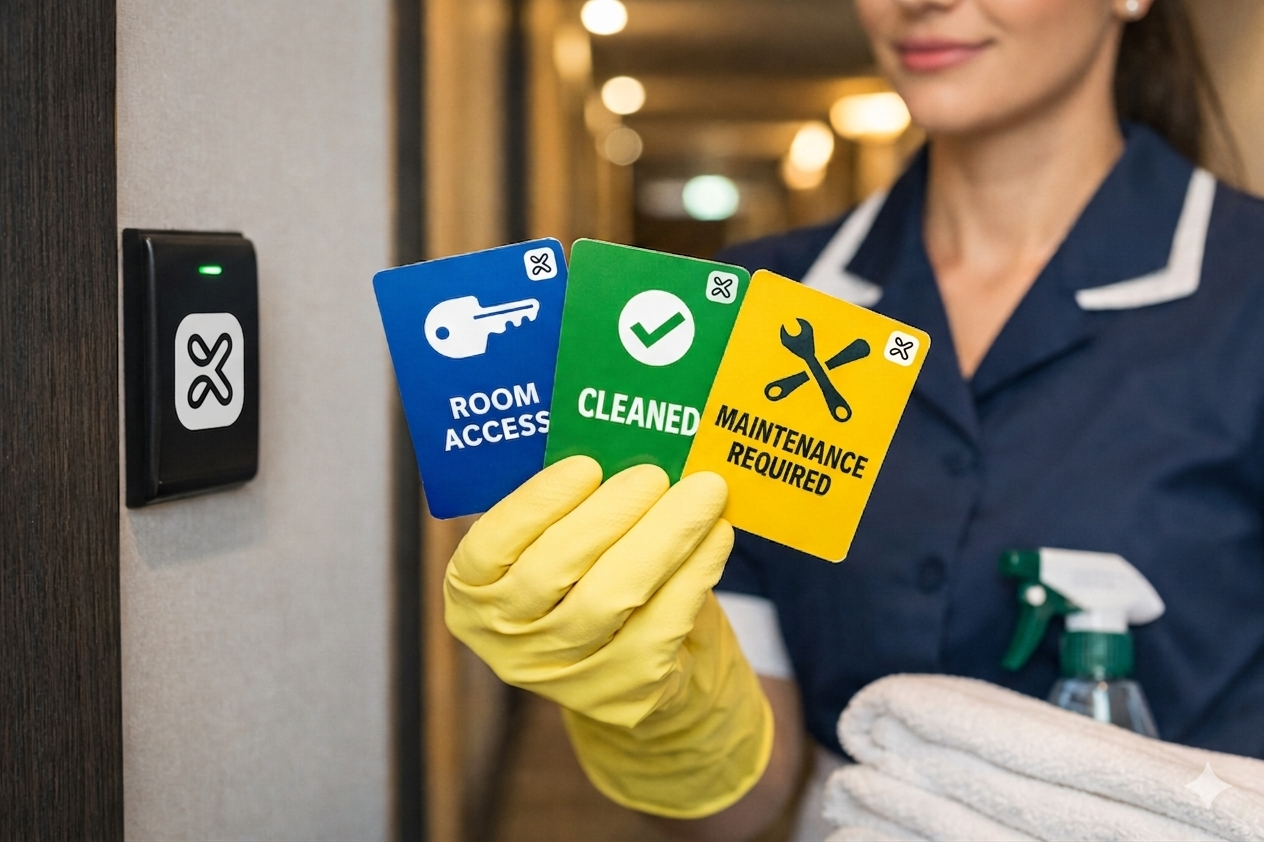
Instead of introducing additional devices, staff can simply carry a small set of RFID cards that communicate status updates back to the system.
Each card contains a unique access code that does not open doors, but instead sends a specific message to the Blyx platform when presented to the reader.
For example:
- Clean completed
- Maintenance required
- Unable to complete clean
- Room currently occupied
When the card is presented at the room’s reader, the system updates the room status automatically.
Management can then see the live progress of housekeeping directly on the Blyx Dashboard.
Simpler for Staff. Better Visibility for Management.
This approach removes the need for additional tablets or handheld devices while still providing the operational data facilities need.
Staff simply carry a small set of clearly labelled cards. When they finish a task, they swipe the appropriate card and the system updates instantly.
No devices to charge.
No screens to manage.
No extra equipment to replace if damaged.
Just a smarter way of using the infrastructure already in place.
Technology That Works With Operations
Blyx is designed to improve efficiency without overcomplicating the way facilities operate.
Rather than adding layers of technology, the focus is on understanding how a site already functions and identifying simple adjustments that can improve visibility, security, and workflow.
Sometimes the most effective solution isn’t adding more systems — it’s allowing the systems you already have to do more.
That flexibility is what makes the Blyx ecosystem different.