

Monitoring Food Storage Performance
Are We Monitoring Food Storage the Best Way?
Food storage and management is a critical responsibility in FIFO accommodation facilities.
When something goes wrong, the consequences can be significant. Replacing damaged food in remote locations can be difficult and expensive. More importantly, improper food storage can create serious health risks if food safety standards are not maintained.
Most facilities already have processes in place to monitor food storage temperatures. But the question is:
Are we collecting the right information — and is it being used effectively?
The Limitations of Traditional Monitoring
In many food service areas, refrigerators and storage equipment display their temperature on a small screen. This works well — as long as someone notices when something is wrong.
The reality is that temperatures can fluctuate throughout the day, often without being noticed by the people working around the equipment.
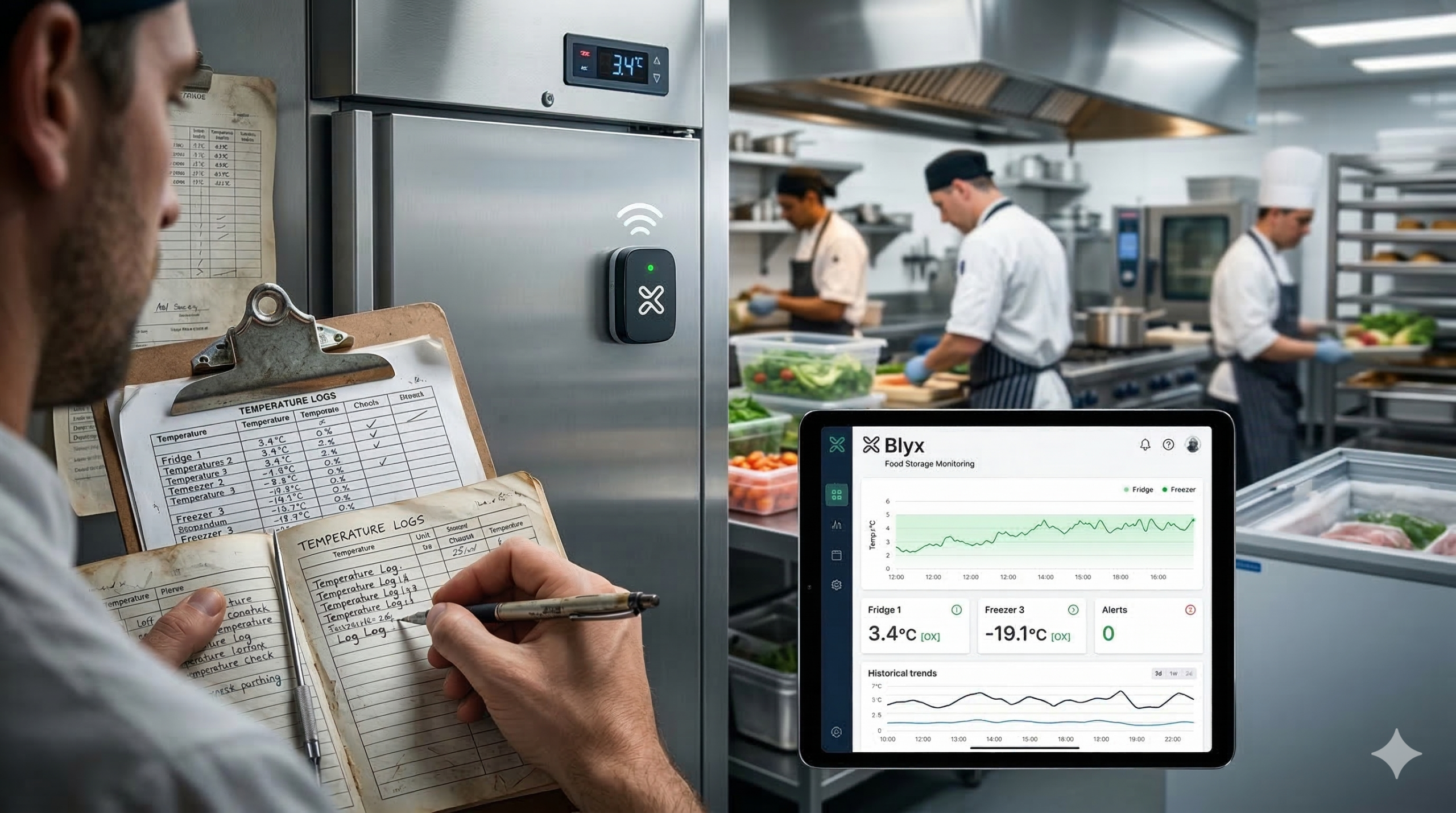
To support food safety compliance, staff typically perform manual checks using temperature probes or infrared guns. These readings are then recorded on paper logs.
While this process meets compliance requirements, it also introduces several challenges:
- Readings are only taken at specific moments in time
- Different staff members may record the data
- The data is often written down quickly during busy shifts
- Once recorded in a book, the information is rarely analysed further
The process works — until something goes wrong.
When a temperature issue occurs, investigating what happened can become difficult. Paper logs provide only snapshots in time, making it hard to understand what the temperature was doing between checks.
Improving the Process with Better Data
This is where technology can help improve the quality of the information being collected.
Blyx can introduce simple temperature monitoring sensors into food storage equipment such as refrigerators, freezers, and cold rooms. These sensors record temperature readings at consistent intervals, creating a much clearer picture of how the equipment is performing throughout the day.
Instead of relying on occasional manual readings, facilities gain continuous data showing how temperature behaves over time.
This provides several advantages:
- No gaps in the data
- Clear historical records for compliance and investigation
- Early identification of abnormal temperature behaviour
- Better understanding of how equipment is performing
Most importantly, the data is stored digitally, allowing it to be visualised and analysed rather than sitting unused in a logbook.
Faster Response to Potential Issues
Another key benefit is the ability to respond quickly when something abnormal occurs.
The Blyx system can trigger alerts when temperatures move outside the acceptable range. These notifications allow staff to investigate the issue immediately, reducing the risk of food spoilage or safety concerns.
Often temperature fluctuations are temporary and not a cause for concern. However, if abnormal behaviour begins occurring frequently or for extended periods, it can indicate a developing issue with the equipment.
With clear historical data, facilities can identify these patterns early and take action before a problem escalates.
Supporting Staff, Not Replacing the Process
Importantly, Blyx does not need to replace existing food safety processes.
Staff can still perform their routine checks as required. However, instead of manually recording temperature readings, they can simply confirm through the system that the monitored temperatures are within the acceptable range.
This approach improves the process in two ways:
- It ensures continuous temperature monitoring is always occurring
- It confirms that staff checks are still being completed
The system supports the team rather than adding additional workload.
Putting Data Into Context
Collecting data is important — but making that data useful is even more valuable.
When information is written in a logbook, it rarely goes beyond that point. It becomes difficult to analyse trends or identify when data stops being recorded altogether.
Digital monitoring allows the data to be presented in dashboards and reports where patterns can be identified and decisions can be made with confidence.
For example, temperature data may reveal issues that would otherwise go unnoticed, such as:
- A refrigerator cycling into defrost mode incorrectly
- Temperature instability following a power outage
- Equipment slowly losing performance over time
These types of issues are difficult to detect with occasional manual checks but become much clearer when continuous data is available.
Monitoring Through Power Interruptions
Power outages can create additional uncertainty for food storage.
When power is restored, it can be difficult to determine what happened to the temperature inside the fridge or freezer during the outage and whether the stored food remains safe.
Blyx monitoring devices can continue recording environmental conditions independently, ensuring facilities have reliable information to assess the impact of an outage and make informed decisions about food safety.
Better Data. Better Decisions.
Food safety in accommodation facilities depends on reliable processes and accurate information.
By introducing simple temperature monitoring and digital data collection, Blyx helps facilities improve the visibility of their food storage operations without overcomplicating the workflow for staff.
The goal isn’t to replace the process — it’s to improve the quality of the information that supports it.
Because when the right data is available, in the right format, at the right time, facilities can make better decisions that protect both their guests and their operations.