


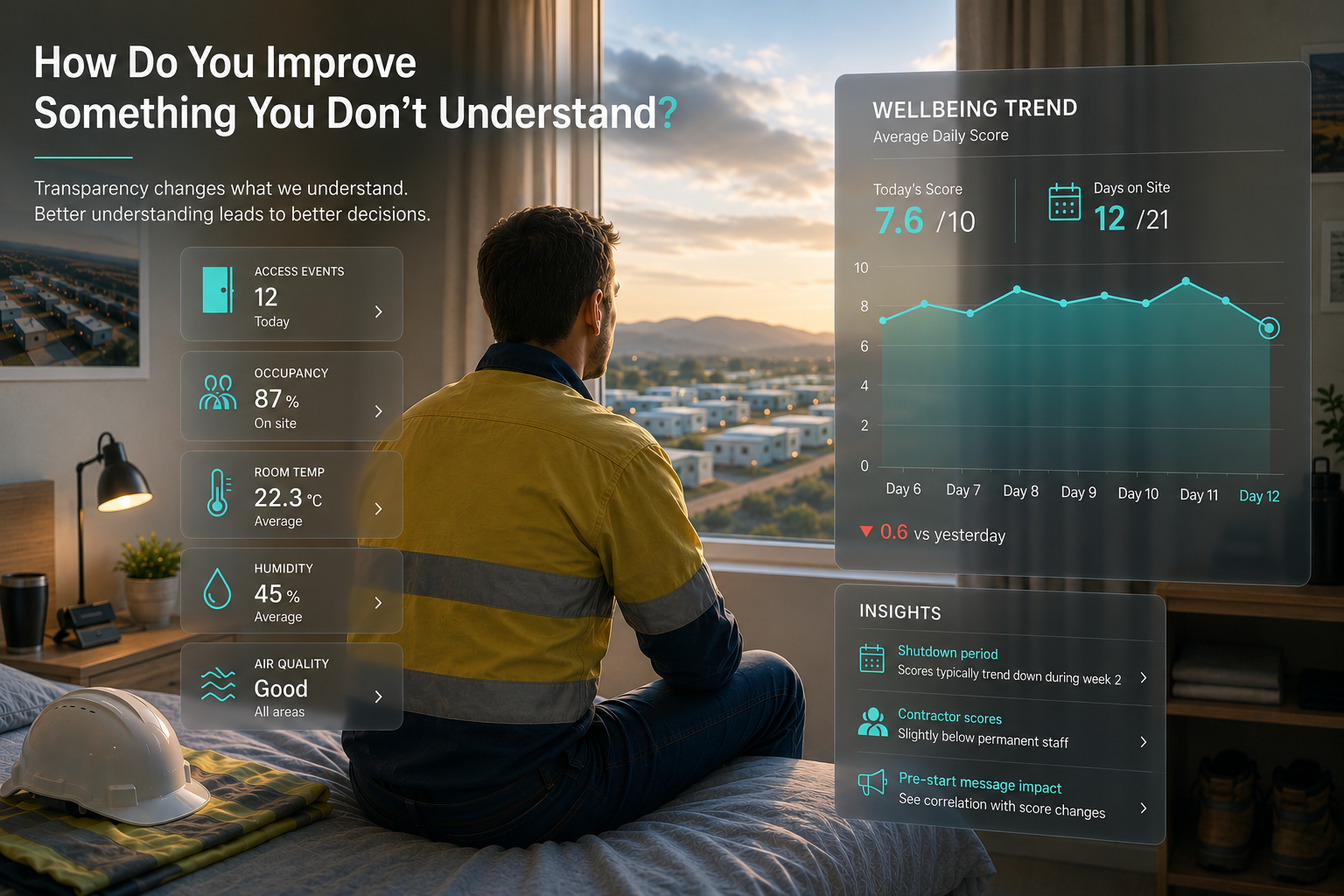
How Do You Improve Something You Don't Understand?
Transparency is valuable because it changes what we understand. Better understanding leads to better decisions.
Imagine two people walk into a doctor’s surgery.
Both say exactly the same thing.
“I’ve got a cough.”
That doesn’t tell the doctor very much.
One has a temperature.
The other has asthma.
One has been sick for two days.
The other for six weeks.
The symptom is the same.
The diagnosis isn’t.
Doctors don’t prescribe treatment because someone has a cough.
They ask questions.
They look for more symptoms.
They diagnose.
Only then can they decide on the most effective treatment.
Facilities aren’t much different.
Someone says they don’t feel safe.
Someone reports inappropriate behaviour.
Someone complains about their room.
These are all symptoms.
The challenge isn’t recognising that something is wrong.
It’s understanding why.
Without understanding the environment, we’re often treating the symptom rather than the cause.
What Does "Feeling Safe" Actually Mean?
Recently I asked a few friends whether they felt safer travelling in an Uber than a taxi.
I wasn’t trying to prove a point.
I was simply curious whether they saw it the same way I did.
One friend loved that every trip was recorded and easy to share with family or friends. For her, knowing someone always knew where she was made her feel safer.
Another friend completely surprised me.
She actually preferred taxis.
For her, safety had nothing to do with journey tracking. She valued the additional licensing and accreditation required for taxi drivers because it gave her greater confidence in the person behind the wheel.
Neither answer was wrong.
They were simply defining safety differently.
That conversation reinforced something we’ve believed while designing Blyx from the beginning.
If people experience safety differently, then understanding those experiences becomes just as important as deciding what technology to install.
The same solution won’t always solve the same problem.
Understanding Before Solving
Many organisations genuinely want to create safer, better environments.
They introduce new policies.
More training.
More lighting.
More security.
More cameras.
Some of those changes will absolutely help.
Others may have little impact at all.
Not because they were bad ideas.
But because they weren’t solving the problem people were actually experiencing.
The first step shouldn’t always be asking,
“What should we change?”
Sometimes the better question is,
“What are we not understanding yet?”
Looking Beyond the Door
One of the biggest challenges with understanding any environment is participation.
Most people already have more apps than they want. Asking them to download another application simply to answer surveys or provide feedback rarely delivers consistent engagement.
Blyx approaches this differently.
Because the app is already part of everyday access to the facility, there’s no need to introduce another platform, another login or another habit. Instead of asking people to adopt something new, Blyx leverages something they’re already using.
That creates a unique opportunity.
Whether someone is an employee, contractor, shutdown worker or a short-term guest doesn’t matter. If they’re staying within the facility, they’re already part of the same platform and can contribute to understanding how that environment is performing.
Rather than collecting information from isolated groups or relying on occasional surveys, everyone becomes part of the same picture.
Only then does access control become much more than a way of opening doors.
When it’s designed to collect the right information, it has the potential to help facilities better understand how people experience the environment around them.
Unfortunately, not every electronic access control system is designed this way. Many simply replace a physical key with a digital credential, without creating any additional understanding of what is happening across the site.
Blyx was designed differently.
Rather than treating access control as the end goal, we see it as the beginning of understanding the facility.
Imagine if, after accessing your room at the end of the day, the app simply asked:
“How was your day?”
One question.
One score.
Optional comments.
Completely anonymous if preferred.
On its own, that interaction doesn’t tell you very much.
But repeated across hundreds of guests, every day, patterns begin to emerge.
Do people feel differently during shutdown periods?
Has a recent initiative genuinely improved the experience of staying on site?
Do certain times of the year create different challenges?
Or perhaps today’s scores suddenly drop across the facility.
Did something happen on site?
Was there a change in the atmosphere?
Did a message delivered at pre-start affect how people felt throughout the day?
Or maybe the opposite happened, and a visit from leadership or a positive site achievement lifted morale.
Instead of waiting weeks or months for issues to surface, organisations gain a much earlier understanding of how the environment is changing and can start asking better questions while those changes are still happening.
Instead of relying solely on assumptions, isolated incidents or annual surveys, facilities begin building a much clearer understanding of the environment they’re responsible for.
Because the value isn’t in collecting more information.
It’s in understanding what that information is telling you.
From Symptoms to Solutions
Transparency can influence behaviour.
Sometimes because people know their actions are visible.
But perhaps its greatest value is something else entirely.
Transparency changes what we understand.
And better understanding changes the decisions we make.
For the people staying within a facility.
For the teams operating it.
And for the people sitting around the boardroom table deciding where to invest next.
Blyx isn’t here to tell organisations what “safe” should look like.
Every site is different.
Every workforce is different.
Every person’s experience is different.
Our goal is to help organisations better understand the environment they’re responsible for, so they can make informed decisions, measure the effectiveness of those decisions and continue improving over time.
Because if we can see more of the symptoms…
We have a much better chance of solving the real issues.