


Blyx Access & Environment Control
What Is an Environment Controller — and Why Should You Care?
When we say Blyx is an access and environment control platform, access is usually easy to understand. Access granted, doors open, doors close.
Environment control is different — and often misunderstood.
At its simplest, the Blyx Environment Controller helps you understand what’s really happening inside a room, not just whether someone can get into it.
It quietly collects information about the room every few minutes and puts that data into context, so facilities can prevent issues instead of reacting to them.
So What Does It Actually Do?
The Blyx Environment Controller does two important things:
it monitors what’s happening inside a room, and it can control parts of that environment when action is needed.
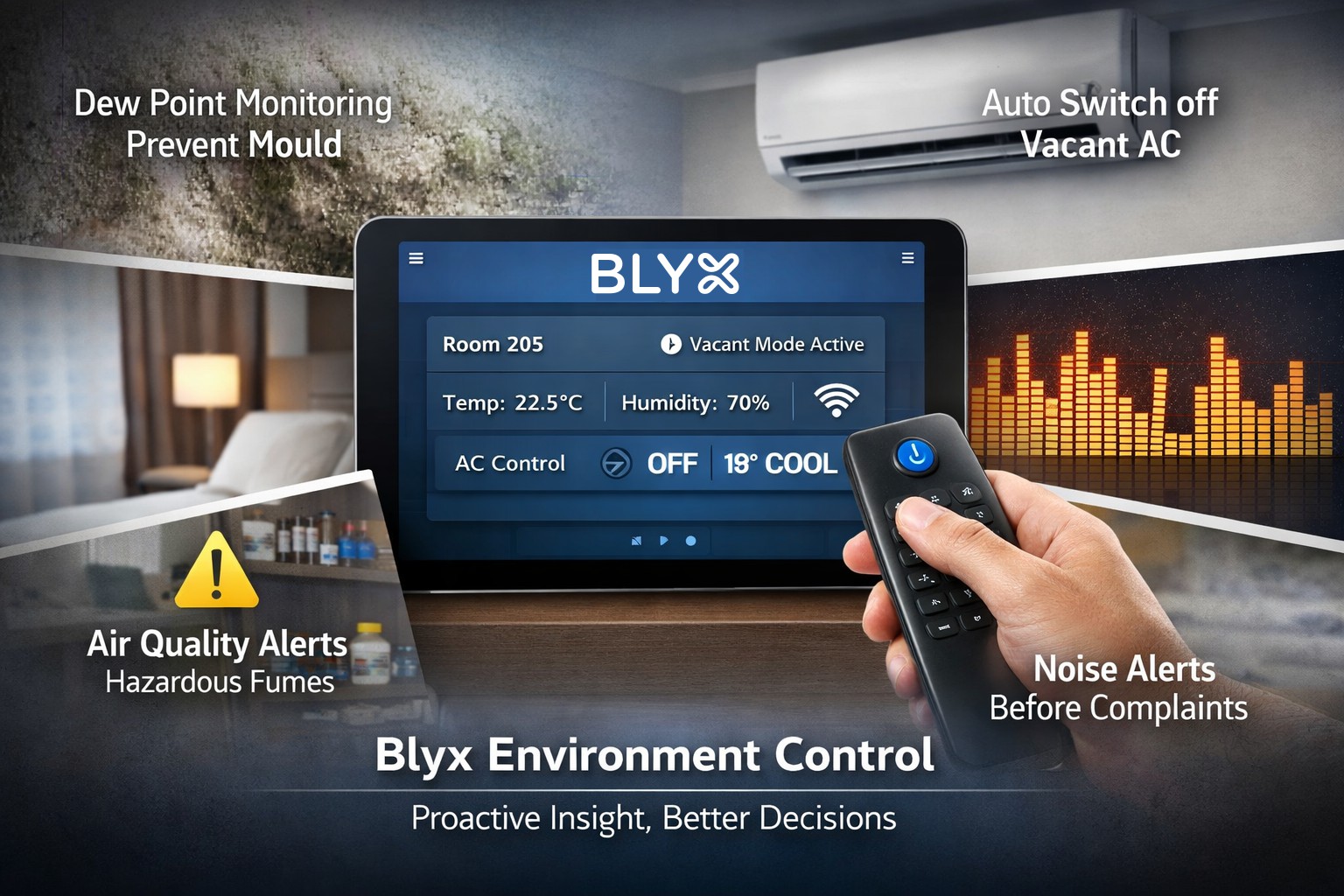
At its core, the controller continuously measures temperature, humidity, and light levels to build a clear picture of how a room behaves over time. Depending on the type of room and what you need to manage, additional modules can be added to extend that capability — such as detecting whether someone is in the room, controlling air conditioning or TVs, monitoring noise levels, or checking air quality.
This means Blyx isn’t just collecting data — it’s understanding how a room is being used, how conditions are changing, and when intervention may be required. It can trigger actions automatically, surface issues early, or simply provide the insight needed to make better decisions.
Think of it as giving the room a voice — and the ability to respond.
Real Examples, Real Problems
🌫️ Preventing mould before it becomes a problem
Mould doesn’t appear overnight. It develops when temperature and humidity remain out of balance for extended periods — often without anyone realising.
By monitoring both together, Blyx can identify rooms that are trending toward mould risk long before it becomes visible. When combined with occupancy data, the system can also highlight situations where moisture is being introduced — such as showers — but humidity levels aren’t dropping as expected afterward. This can indicate that extraction fans aren’t operating effectively, allowing moisture to linger and create the perfect conditions for mould.
Instead of waiting for visible damage or guest complaints, rooms can be flagged early and addressed quietly — protecting both the building and the guest experience.
❄️ Knowing the AC isn’t working — before the guest does
The Blyx Environment Controller can control AC units and TVs using an infrared emitter — like a universal remote built into the system.
Before a guest arrives, Blyx can turn the AC on automatically. The temperature data then confirms whether the room is actually cooling or heating as expected.
If the temperature doesn’t move? Maintenance can be alerted before check-in, not after a frustrated call to reception.
🌙 Supporting night-shift workers
Not all rooms behave the same.
Light levels vary depending on building orientation, window placement, and time of day. Blyx can help identify which rooms stay darker and quieter during daylight hours — making them better suited for night-shift workers who need proper rest.
It can also confirm when lights are left on in unoccupied rooms, reducing wasted energy.
📢 Managing noise before complaints happen
Noise complaints are disruptive — especially in shared accommodation.
Blyx can be fitted with an acoustics module when needed, allowing teams to understand when and where noise levels are increasing. This can be used temporarily to validate complaints or permanently in common areas to help security intervene early.
Instead of reacting to angry calls, issues can be addressed before they escalate.
⚠️ Improving safety with air quality monitoring
In certain rooms — such as chemical storage or plant areas — air quality matters.
Blyx can monitor CO₂, VOCs, or other airborne risks and raise alerts if levels become unsafe. When paired with Blyx access control, even door readers can visually signal an issue, warning people before they enter.
It’s about awareness, not alarms after the fact.
None of this data is useful on its own.
What makes Blyx different is that it adds context — combining room conditions, occupancy, access, and time to help facilities understand why something is happening, not just that it happened.
Over time, this data paints a clear picture of how rooms are used, how conditions change, and where small adjustments can make a big difference.
The Real Question Isn’t “What Does It Measure?”
It’s:
What do you want to make better?
Because once the infrastructure is in place, Blyx can often help solve problems facilities didn’t even realise were solvable.