


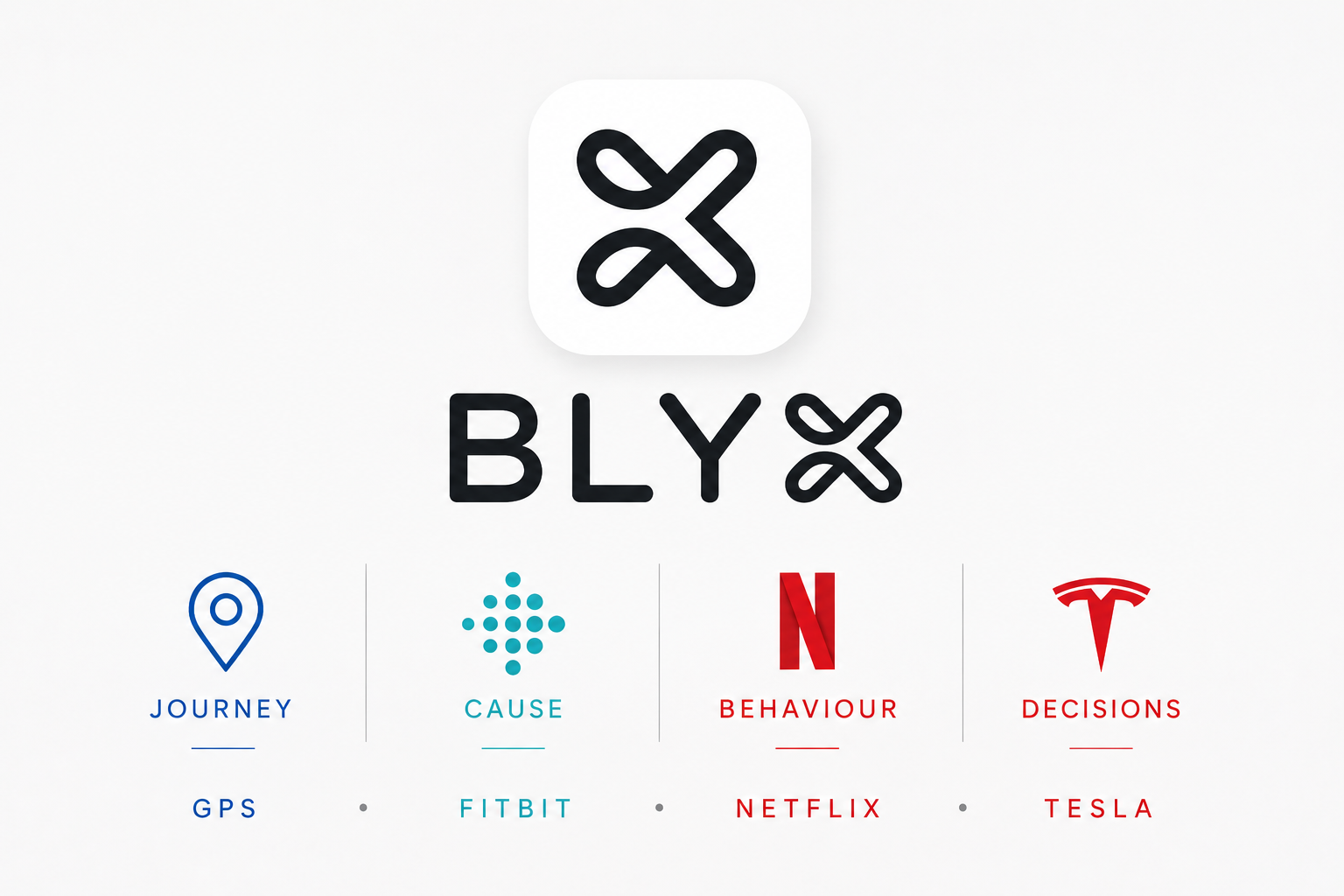
What GPS, Netflix, Fitbit and Tesla Can Teach Us About Facility Management
One of the hardest things to explain about Blyx is that it’s not really an access control system.
Yes, it controls doors.
But if that was all it did, we probably wouldn’t be writing this article.
What makes Blyx interesting isn’t the ability to lock and unlock a room. It’s the information that comes from understanding what is happening within a facility and putting that information into context.
That might sound a little boring at first.
After all, who gets excited about data?
The reality is that some of the biggest changes in industries over the last 20 years have happened because technology filled information gaps that nobody had a practical way of understanding before.
The technology itself was often the easy part.
The real value came from what people learned once they could finally see what was happening.
GPS Didn't Just Tell Us Where Vehicles Were
When most people think about GPS, they think about navigation.
The transport industry thinks about something very different.
Before GPS, a transport company generally knew when a vehicle left and when it arrived. If a delivery took longer than expected, there were usually plenty of theories available.
- Traffic.
- Roadworks.
- Weather.
- Vehicle issues.
- Driver behaviour.
The challenge wasn’t a lack of explanations.
The challenge was that nobody really knew what happened during the journey.
GPS filled that information gap.
For the first time, companies could see the actual story behind every trip. They could understand where vehicles spent time idle, which routes consistently took longer, where fuel was being consumed and how different drivers approached the same task.
The biggest benefit wasn’t knowing where a truck was at any given moment.
It was understanding what happened between departure and arrival.
That visibility allowed businesses to improve planning, support drivers more effectively and make decisions based on evidence rather than assumptions.
Facilities have similar information gaps.
Take housekeeping in an accommodation village.
Management knows rooms are being cleaned and guests are being serviced, but very few facilities understand the journey staff are taking to complete that work.
How often are housekeeping staff returning to supply rooms?
Which accommodation blocks take the longest to service?
Are staff spending unnecessary time walking back and forth between locations?
Could room allocations be adjusted to improve efficiency?
The purpose isn’t to watch staff.
It’s to understand the journey.
Perhaps larger trolleys would reduce trips back to storage areas. Perhaps consumables should be located closer to accommodation blocks. Perhaps room allocations could be grouped differently to reduce unnecessary movement.
Just like GPS, Blyx helps reveal what is happening between the start and finish of a task so facilities can make better decisions about how work is performed.
The 10,000-Step Goal Only Works Because Someone Started Counting
Most people know that exercise is good for them.
Most people also know they should probably get more sleep.
But before fitness trackers became popular, much of our understanding of personal health was based on assumptions.
“I’ve been really active this week.”
“I don’t think I’ve slept very well.”
“I feel exhausted today.”
Then wearable fitness trackers arrived and changed the conversation.
Suddenly people could see exactly how many steps they were taking, how long they were sleeping, what their heart rate was doing and how well they were recovering.
Something interesting happened.
People realised that how they felt wasn’t always an accurate reflection of what was actually happening.
Sometimes the reason you felt exhausted wasn’t because you’d had a bad day. It was because you’d unknowingly walked 18,000 steps.
Sometimes the reason you felt great wasn’t because of an extra gym session. It was because you’d finally had a good night’s sleep.
The technology didn’t make people healthier.
It helped them understand which factors were actually influencing the outcome they were trying to achieve.
Facilities face the same challenge.
Most operators know that mould is influenced by humidity, airflow and temperature.
Most know that extraction fans and air conditioners play an important role.
But how many actually know what is happening inside a room at 2am?
What happens after a guest takes a hot shower?
What happens when a room sits vacant during a humid week?
What conditions are present immediately before mould starts to appear?
Without data, facilities are often making decisions based on assumptions.
Blyx helps fill that information gap by monitoring room conditions over time and putting those conditions into context with occupancy and external weather patterns.
The goal isn’t to collect temperature readings.
The goal is to understand what is actually influencing room health so that the right actions can be taken.
Just like wearable fitness trackers, the value isn’t in the numbers themselves.
The value comes from understanding what those numbers mean.
Netflix Didn't Just Change Entertainment
Before streaming services, movie studios already had plenty of data.
They knew how many cinema tickets were sold.
They knew how many DVDs were purchased.
They knew how many rentals took place.
What they didn’t know was what happened afterwards.
Did people finish the movie?
Did they stop watching halfway through?
Which actors kept viewers engaged?
What content did people binge-watch?
What shows were being rewatched again and again?
Netflix filled a huge information gap.
For the first time, entertainment companies could understand viewing behaviour instead of simply measuring purchases.
That deeper understanding changed what content was created, how it was marketed and how success was measured.
The same thing happens inside facilities.
Most sites already collect information.
The challenge is that it often exists in isolation.
There might be access control data.
There might be utility consumption data.
There might be maintenance records.
There might be occupancy information.
Individually, each data set tells a small part of the story.
Together, they start to reveal how a facility actually operates.
How often are laundry facilities reaching capacity?
Are gym facilities being used as expected?
Are there patterns between occupancy and energy consumption?
Are dining facilities being sized correctly?
Are refrigeration systems performing consistently?
Blyx is designed to bring these pieces together into a digital representation of what is happening across a facility.
Just as Netflix moved beyond understanding what people bought to understanding how they behaved, Blyx helps facilities move beyond isolated data points to understanding how the whole environment functions.
Tesla Didn't Just Build Electric Cars
One of the biggest changes Tesla introduced had nothing to do with electric motors.
It was the way information flowed back to the people making decisions.
Traditionally, manufacturers learned about problems through warranty claims, dealer reports, service centres and customer complaints.
Information travelled slowly.
Sometimes it never made it back at all.
Tesla shortened the distance between what happened and who needed to know about it.
Vehicle performance, faults and operational data could be collected continuously and analysed much sooner.
Problems became visible earlier.
Decisions became faster.
Improvements happened sooner.
Facilities have traditionally worked much the same way.
A room speaks when someone complains.
A building gets attention when something breaks.
A problem becomes visible when an inspection occurs.
Most facility decisions are still made using a combination of meetings, reports, surveys and feedback from onsite teams.
While all of those things are valuable, they are also opinions and observations from individual perspectives.
Two people can experience the same situation and describe it very differently.
Blyx helps bridge that information gap by creating a digital twin of the facility.
Instead of relying solely on what people believe is happening, decision-makers can see what is actually happening.
How many rooms are occupied?
How quickly are rooms being turned over?
Which areas are experiencing the highest levels of activity?
When are facilities reaching peak demand?
Where are maintenance issues occurring most frequently?
How are occupancy patterns influencing energy consumption and operational workloads?
The goal isn’t to replace people.
It’s to give more people access to the same information so they can work together to make better decisions.
Just like Tesla reduced the distance between what happened in a vehicle and the people responsible for improving it, Blyx reduces the distance between what is happening within a facility and the people responsible for operating it.
The result is faster decisions, better visibility and a shared understanding of what is really happening across the site.
It's Never Really About the Data
GPS helped us understand the journey.
Fitbit helped us understand the cause.
Netflix helped us understand behaviour.
Tesla helped us improve decisions.
The common thread wasn’t the technology.
It was visibility.
If you want to solve a problem, you need to understand more than just the outcome.
Could the journey have been different?
Do we understand the real cause?
Does behaviour match what people are telling us?
Is the right information reaching the people making decisions?
Blyx helps facilities answer those questions.
Because once you can see what was previously hidden, better decisions become much easier to make.