


Better FIFO Accommodation: Giving Facilities the Tools to Deliver Better Standards
Transparency is valuable because it changes what we understand. Better understanding leads to better decisions.
Recent reporting by PerthNow on research into FIFO accommodation highlights some important improvements workers want to see, including greater control over room temperatures, better sleeping conditions and greater privacy.
These are positive recommendations. But they raise another important question.
How do we help accommodation facilities deliver these improvements without adding more work, increasing operating costs or simply assuming the new standards are being met?
Setting a standard is one thing. Giving facilities the tools to consistently deliver it is another.
That’s where we believe Blyx can help.
The Blyx Ecosystem brings together electronic access control, environmental monitoring and guest communication into one platform. By connecting this information, Blyx aims to make it easier for facilities to improve the guest experience while operating more efficiently.
Let’s look at three recommendations and how they could work in practice.
1. Air Conditioning: Guest Comfort Without Wasting Energy
After a long shift in the heat, there’s nothing quite like walking into a beautifully cold room. And everyone has their own idea of the perfect temperature.
But leaving hundreds of rooms running at 18°C all day while nobody is there can create significant energy costs.
What if guests could have the comfort they want without facilities paying to cool empty rooms?
For the guest
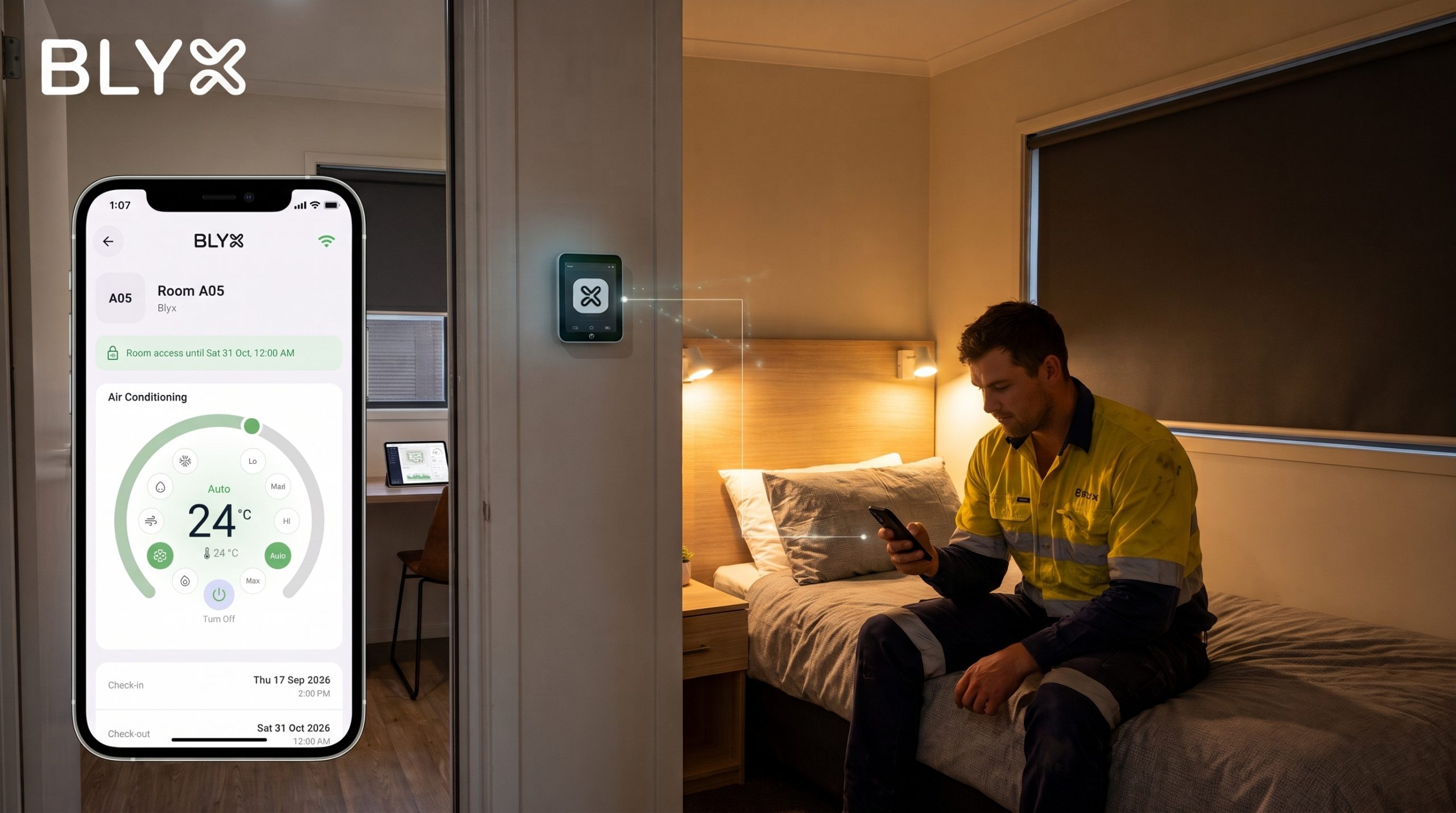
The Blyx App puts room temperature control at their fingertips.
Guests can set their preferred temperature and remotely adjust their air conditioning to suit their needs.
For the facility
Blyx can use occupancy information, roster schedules and environmental conditions to automatically adjust air conditioning when rooms are vacant, then prepare them for guests returning from work.
The same monitoring can identify declining equipment performance.
If one room takes 20 minutes to reach its requested temperature while another takes over an hour, maintenance teams can investigate before the guest returns to an uncomfortable room.
How do we know it’s working?
Facilities can monitor actual room temperatures, equipment performance and energy consumption rather than assuming everything is working because the AC is switched on.
The outcome: Greater comfort for guests, less wasted energy and fewer unexpected maintenance issues.
2. Noise and Lighting: Better Sleep Without Guesswork
Installing blackout blinds and improving sound insulation are sensible recommendations.
But how do we know whether they’re doing their job?
A room might have brand-new blackout blinds but still let in too much light. Another might meet building specifications but regularly experience disruptive noise.
And these issues aren’t limited to night-shift workers. Everyone needs an environment where they can get adequate rest.
What if facilities could understand actual room conditions rather than waiting for complaints?
For the guest
Environmental monitoring can help facilities provide rooms better suited to guests’ sleeping requirements.
For example, historical noise data could help identify quieter rooms for night-shift workers needing to sleep during the day.
For the facility
Blyx can monitor light and sound levels during normal facility operations, helping operators identify problem areas, make more informed room allocations and prioritise improvements.
The facility map can also indicate when someone is present in their room, helping staff avoid scheduling noisy work nearby while guests may be resting.
Importantly, Blyx measures sound levels without recording conversations and detects human presence without monitoring what guests are doing. Staff don’t have to rely on a Do Not Disturb sign being displayed.
How do we know it’s working?
Facilities can compare light and noise levels before and after improvements such as blackout blinds or acoustic treatments.
The outcome: Better sleeping conditions for guests and real data to help facilities make smarter decisions about room allocations and improvements.
3. Room Access: Greater Privacy Without More Administration
Guests should feel confident that their room is secure and that staff access is appropriate and accountable.
Electronic access control already provides a way to manage and record entry. But what if that information could be more useful?
For the guest
Through the Blyx App, guests can access their room and see when it has been entered during their stay.
Where access is linked to scheduled work, they can also see the reason, such as housekeeping or maintenance.
For the facility
Blyx can connect staff access permissions with housekeeping and maintenance schedules, reducing the need for unrestricted master access.
Scheduled work provides context for access records, while a visual facility map helps operators identify unusual activity without searching through spreadsheets.
How do we know it’s working?
Facilities can review access activity, identify patterns requiring investigation and demonstrate how room access is being managed.
The outcome: Greater privacy and transparency for guests, with simpler access management and better accountability for facility staff.
Making Better Standards Easier to Deliver
These examples highlight an important opportunity.
Improving accommodation standards doesn’t necessarily have to mean more work for the people responsible for delivering them.
With the right information and automation, it could mean less.
An underperforming air conditioner can be identified before a complaint.
Room allocations can consider actual noise conditions rather than just availability.
Housekeeping and maintenance access can be managed through scheduled permissions.
And improvements can be monitored without relying entirely on manual inspections and reports.
Blyx is designed to connect this information, helping operators identify issues earlier and make everyday facility management more efficient.
Better Communication, Better Preparation
Room conditions are only part of the accommodation experience.
Facilities also need to understand who is coming, what they need and how they’re experiencing their stay.
Through the Blyx App, guests can share information such as dietary requirements and accommodation preferences before arriving.
Combined with booking and roster information, this helps facilities prepare catering requirements, reduce waste and provide a more personalised experience.
Guests can also access facility information, dining times, social activities and important safety updates.
With Blyx connected to access control, operators have better visibility into who is staying on site and a direct channel to communicate with relevant guests.
The App also creates an opportunity for two-way feedback.
Much like Uber’s rating system, guests can share their experiences while facilities gain a better understanding of operational challenges and guest behaviour.
The goal isn’t more paperwork. It’s better information that helps everyone have a better experience.
From Better Standards to Better Outcomes
Installing new equipment or meeting a building specification doesn’t necessarily mean the intended improvement has been achieved.
By combining environmental monitoring, access information and guest feedback, Blyx can help facilities understand actual conditions, identify where improvements are needed and measure whether changes are working.
This gives accommodation providers a clearer way to demonstrate progress without adding more reporting and administration.
Better standards are an important step. Giving facilities the tools and information to deliver them is just as important.
Because the more we understand about what is happening within a facility, the better equipped we are to improve it.